Showing posts with label Robots. Show all posts

Wednesday, June 10, 2009

Scale in modeling

I'll try and keep this one short. Maybe 1/72? Heh...


Scale in modeling terms is the fraction of size a model is compared to the real deal. Let's say you had a statue - a model, sort of - that was twice the size of your height - let's say, 5' 10", that's a good random number.


Model kits, on the other hand, are SMALLER versions of real life things. If a fighter jet is 20 meters long in real life, then a 1/72 scale model kit - this would be fairly large - the model kit would be roughly 28 centimeters long. That translates to between 11 inches and one foot in length. Displaying that on a stand would end up taking a lot of your desk or shelf space.


Even models of giant robots tend towards a scale system. In Japan, the people who write the giant robot shows pride themselves on fictional specifications - the dry weight versus the fueled weight, the various demensions, range and top speed, etc. Because of this, the model makers tend to have a lot of hard data for their designs. A 1/100 scale Gundam would be .18 meters tall... or 18 centimeters, which works out to about 7 inches tall, because the Gundam was specified as being 18 meters tall.


Silly, right? They just DECIDE it's 18 meters, even though the thing's not... actually... hey what's that in the distance...


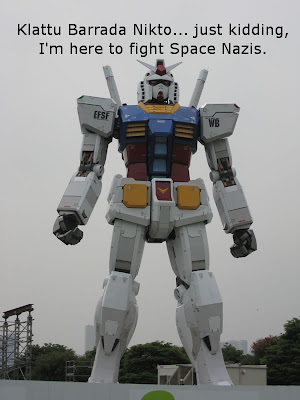
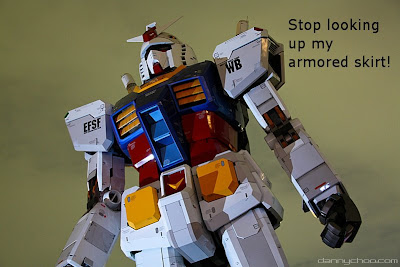
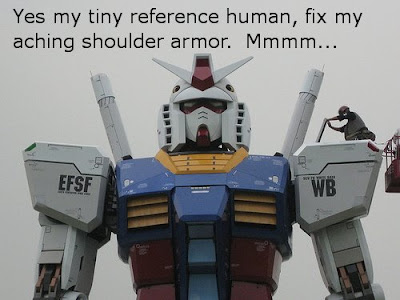
A little known project the Japanese have been working on for a few months (yeah they started this earlier in the year. Scary right?) is a 1/1 scale "model" of the RX-78-2 Gundam mobile suit. Now don't worry, it's not actually mobile. But it's not quite a statue either - it is, honestly, a model kit. A model kit that's exactly the same size as the "real" Gundam would be... but it's made of individually machined peices that were crafted together - it has joints and everything! It's apparently going to be part of an attraction and the cockpit will be open to sit in, and play a little movie for anyone who sits inside it. Rad!


It's currently located in Odaiba, Japan, but will be disassembled (!!! Yikes!!!) and moved to its final location later. Here's a few more pics - you can get a personal story here. Man am I jealous. And on a side note - all the cynics saying how lightning is going to strike this thing, bring it to life, and cause it to rampage through Tokyo are forgetting this is a GOOD GUY. It's not like they built a Zaku.


EDIT: I was wrestling with the formatting of this post all evening when I put it up, and I ended up with a duplicate paragraph! And I re-read that post a dozen times. Just goes to show - don't make posts after midnight! They get all scaley and mean...

Thursday, June 4, 2009

Mobile Suit Whatnow?

Well my sister, who is a darling and a saint, actually read through that entire first post I made, but she had a question: Gundam? Is that like, Japanese Transformers?

The answer: Uh, not quite. There are Gundams that transform, but Transformers and Gundam are about as different as Spiderman and Star Trek. Actually they're about as different as Spiderman and Dawson's Creek.

The thing that made Mobile Suit Gundam unique and original, when it came out thirty years ago (it just had it's 30th birthday in April, actually), was that all the other robot shows were basically:

"Oh no! A giant monster is destroying the city!"
"Someone must stop it… "
Queue the dramatic music… "We're saved! It's Giant Robo to the rescue!"

Essentially, large robot shows were seen as little more than kid-targeted commercials to sell robot toys, and as far as story was concerned: Giant monster attacks, then hero robot shows up, hero beats monster in highly dramatic fashion, day is saved. Now, repeat 25 times over the course of a four month TV season! And make sure someone's making a toy of that robot, so that you can generate revenue off of the toy sales - it's worth tons of money.

Gundam changed a lot of that.

In the first episode of Gundam, the main characters are living in a space colony that comes under attack for mysterious reasons. It is explained that a war in space was being waged between the Earth Federation (the Good Guys) and the Principality of Zeon -all humans of different sorts - but the main characters thought the war had nothing to do with them. The Zeon are a Nazi-Germany themed group of space colony nationalists who believed the Earth Federation is mistreating their people and declared independence from the Earth government - and started bombing earth from space to enforce their independence. The attack on the main characters' colony was a mission to find a prototype military weapon called "Gundam" that was under secret development in space (the earth Federation apparently thought keeping their secret weapon as far from earth as possible was a good idea. Whoops!)


By the end of the first episode, most of the main characters have lost their entire families in the colony attack. There's a notable scene where one of the women is running towards a shelter, and is lagging behind the rest of the crowd - who are suddenly scattered in all directions by a missile blast. In one second she watches her father, mother and little brother killed right in front of her. This is an important theme of the show: War Is Hell. Try To Survive.

The bad guys on the show were not giant, comical monsters, but rather soldiers of an opposing army who often seemed fairly reasonable, but still decided they would fight for their own country's independence. The main characters rally around the Gundam, a seemingly unbeatable vehicle that combines the firepower of a tank with the mobility of a fighter plane - and had giant, energy swords that could cut through metal like a light saber. However, even though the fights often seemed like over the top, kiddy cartoon stuff, the horror of the enemy pilots' screams as their robots were destroyed were a painful reminder of the truth of armed conflict. War truly is hell, and survival must sometimes take priority over a soldier's personal feelings.

Gundam itself didn't do well until the company Bandai became a sponsor and made model kits for the various robots. Ironically, the practice of turning the robots into toys SAVED Gundam (which had been suffering from poor ratings), and funded a new series called Zeta Gundam (the first to feature TRANSFORMING robots!) in 1985.

The "Military Robot" genre of anime that Gundam started is still being made today. The show Macross and others followed in Gundam's footsteps, making robot war dramas and stories of personal heroism in the face of horror more commonplace. It's a style of Japanese television that is still quite successful today.

Thanks for reading! SUPER GO!